Have you ever wondered how many seconds it takes for your generator to kick in when the mains power goes out? The answer to that question is largely down to the ATS panel. The short answer to "what is an ATS panel" is this: it is a control panel that automatically manages the transfer between the mains and the generator, starts the generator when the power fails, and switches the load back to the mains when it returns. In this article, we will look at the purpose of the ATS, its step-by-step working logic, how it differs from manual transfer, its core components, and which facilities it is critical for, all in plain engineering language.
What Is an ATS Panel?
ATS is the abbreviation of "Automatic Transfer Switch." Its core purpose is to transfer a facility's electrical load safely between two sources. These two sources are usually:
- Main source: Mains electricity (the distribution line).
- Backup source: Diesel generator.
Under normal conditions, the facility is fed from the mains. When the mains fails, the ATS detects this, sends a start command to the generator, and once the generator begins producing voltage, transfers the load from the mains to the generator. When the mains returns, the process runs in reverse: the ATS returns the load to the mains in a controlled manner and stops the generator.
The most important feature of the ATS is that these transitions happen without any human intervention. Even when the power fails in the middle of the night, when no one is at the facility, or at a moment the operator cannot reach, the system works on its own. It is precisely this automation that sets the ATS apart from a simple hand-operated switch.
How Does an ATS Panel Work? Step by Step
The best way to understand the working logic of an ATS is to follow a typical power outage scenario. The steps below show the general operating principle; the actual timing values vary depending on the model, the settings, and the characteristics of the generator.
1. Continuously monitoring the mains
The ATS continuously monitors the mains voltage and frequency. If the voltage drops below the defined limits, disappears entirely, or the phase sequence is disrupted, the panel's control unit treats this as an outage.
2. Confirming the outage (detection delay)
The ATS does not start the generator on every momentary fluctuation. There is an adjustable confirmation delay for brief voltage dips or outages of a few seconds. If the outage persists throughout this period, the system decides it is a genuine fault. This prevents unnecessary generator starts.
3. Start command to the generator
Once the outage is confirmed, the ATS sends a start signal to the generator's control panel. The diesel engine cranks and begins to build up its speed. Especially in cold weather, it can physically take a few seconds for the diesel engine to build up its speed and temperature on the first crank; this is inherent to the nature of diesel engines.
4. Waiting for the generator voltage to stabilize
The ATS does not connect the generator output to the load immediately. First it waits for the generator's voltage and frequency to reach nominal and stable values. Connecting the load to an unstable source can damage both the equipment and the generator.
5. Transferring the load to the generator (transfer)
Once the generator produces stable voltage, the ATS disconnects the load from the mains and transfers it to the generator. There is a critical safety principle here: mechanical and electrical interlocking. The load is never connected to both the mains and the generator at the same time. This interlocking prevents the two sources from mixing (back-feeding) and hazardous situations.
6. Monitoring for the mains to return
While the generator feeds the facility, the ATS continues to monitor the mains. When the mains returns, it again waits for an adjustable confirmation period to be sure of its stability.
7. Transferring the load back to the mains and cooling down
Once the mains returns steadily, the ATS switches the load back to the mains. Then, rather than immediately giving the generator a stop command, most systems allow a cool-down period. The generator runs unloaded for a short while, the engine temperature settles, and then it stops. This is a beneficial practice for engine life.
This cycle resets itself so that it is ready to run again from the start at the next outage.
The Difference Between Manual Transfer and Automatic Transfer
In backup power systems, load transfer is carried out by two basic methods: manual and automatic. Understanding the difference between the two is important for choosing the right solution.
Manual transfer switch (MTS): When the mains fails, an operator has to come to the panel, turn the switch by hand, start the generator, and transfer the load. When the mains returns, the same operations are performed in reverse, again by hand. It is lower in cost, but it requires someone on duty at all times, and the time between the outage and coming online depends entirely on a person.
Automatic transfer switch (ATS): It carries out all the steps described above without any human intervention. It detects the outage, starts the generator, transfers the load, and switches back when the mains returns. The time between the outage and coming online is much shorter and more consistent.
The table below compares the two approaches. The values are representative and vary according to the needs of the facility.
| Feature | Manual Transfer (MTS) | Automatic Transfer (ATS) |
|---|---|---|
| Coming online | Requires an operator | Without human intervention |
| Typical transfer time | Depends on how long staff take to arrive | Usually on the order of seconds (approximate, varies with settings) |
| At night / when no one is at the facility | Outage continues | Comes online automatically |
| Initial investment | Lower | Higher |
| Suitability for critical facilities | Limited | High |
As can be seen, an ATS provides a clear advantage over the manual solution in places where continuous supply matters.
The Core Components of an ATS Panel
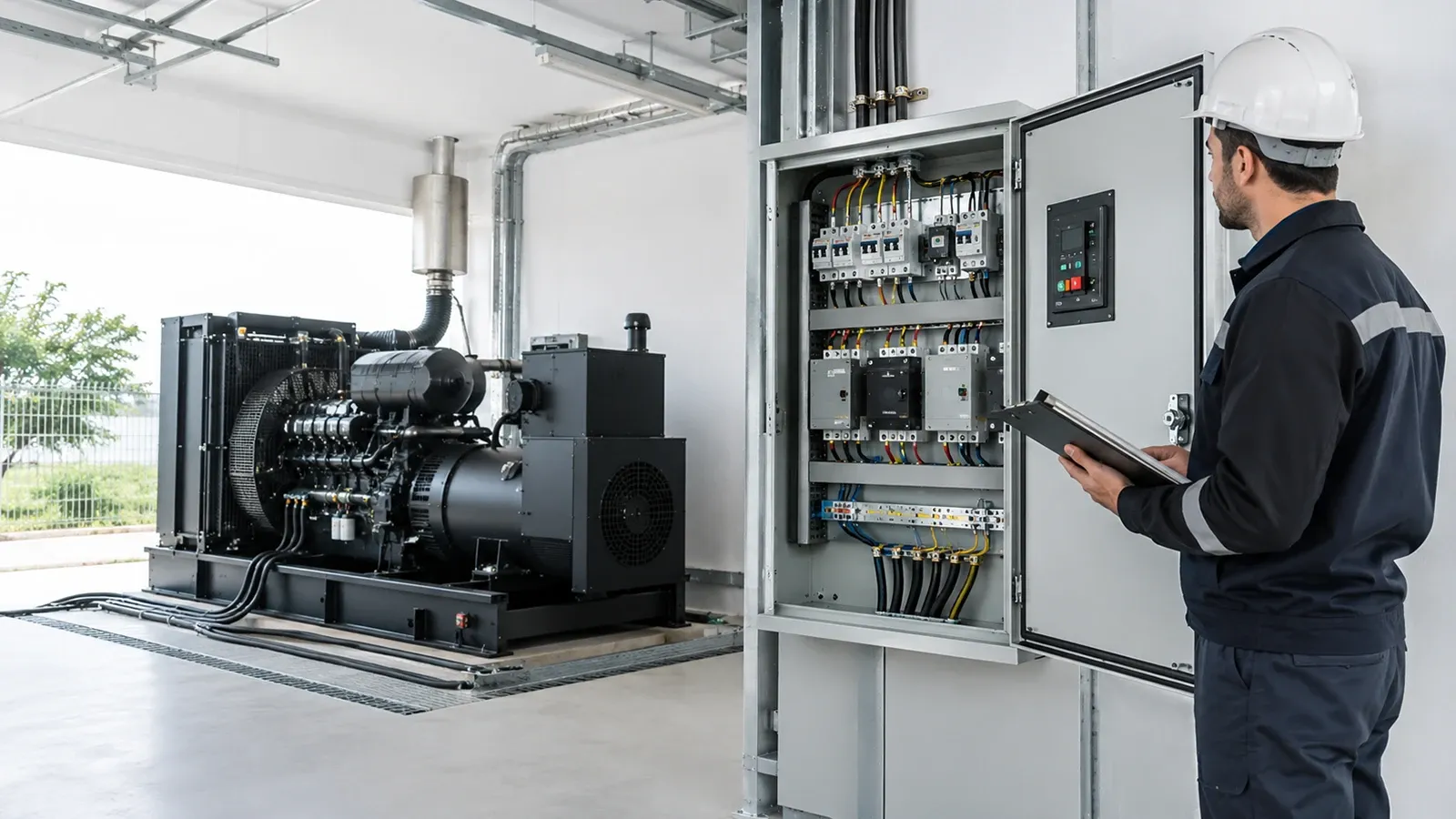
An ATS panel is made up of several main components that carry out different functions together. Although the details vary by brand and model, the basic structure is similar:
- Control unit (controller): The brain of the panel. It monitors the mains and generator voltage, manages the delay periods, and issues the start and stop commands. Adjustable parameters are set through this unit.
- Transfer mechanism (contactors or motorized switches): The power switching elements that physically transfer the load from one source to the other.
- Mechanical and electrical interlocking: The safety mechanism that prevents the mains and the generator from being connected to the load at the same time.
- Voltage and frequency sensing circuits: Measure whether both sources are healthy.
- Control and signal connections: Carry the start, stop, and status signals between the ATS and the generator control panel.
- Protection elements: There may be components that provide protection against situations such as overcurrent and short circuit.
The size and internal equipment of the panel are determined by the current it will carry and the power of the facility. For this reason, ATS selection should be evaluated together with the generator and the facility load.
Which Facilities Is an ATS Critical For?
An ATS gains value anywhere that electricity needs to return uninterrupted or in the shortest possible time. The greater the need for continuous power, the greater the importance of the ATS. Prominent examples:
- Healthcare institutions: Places where life-critical equipment operates, such as hospitals, dialysis, and imaging centers.
- Data centers and server rooms: Environments where even a brief outage can lead to data loss and service disruption.
- Manufacturing facilities: Factories where an outage can halt the production line and cause product loss or machine failure.
- Cold chain and food storage: Facilities where cooling must continue.
- Shopping malls, hotels, and business centers: Buildings that need continuity of lighting, elevators, and security systems.
- Communication and infrastructure facilities: Critical infrastructure such as base stations and pumping stations.
In such facilities, the delay introduced by manual transfer may be unacceptable. By removing the human factor, an ATS secures continuity of supply.
ATS and Generator Compatibility
The ATS is not a standalone solution; it works as a whole with the generator. For the right outcome, several points need to be compatible:
- Power compatibility: The ATS current capacity must be selected to match the power of the generator and the facility load. For diesel generators in the 10 kVA - 1100 kVA range in the Nidexa product line, an ATS of a suitable capacity is evaluated according to the facility load.
- Signal compatibility: The start and stop commands sent by the ATS must communicate correctly with the generator control panel.
- Reserve margin and load calculation: To size the generator, and therefore the ATS, correctly, it is important to accurately calculate the facility's total power and reserve margin. With the power calculation tool on our site, you can see the approximate kVA requirement from your total kW value.
- ESP and PRP distinction: Whether the generator will be used as backup power (ESP) or continuous power (PRP) affects the system as a whole. This distinction is defined during product selection.
Correctly sizing, connecting, and commissioning an ATS are tasks that require expertise. Incorrect installation can lead to problems such as a slow transfer or a safety gap. For this reason, commissioning the ATS and the generator together should be carried out by teams experienced in the field. At Nidexa, we provide guidance for an ATS solution compatible with your generator and for the installation and commissioning service.
Frequently Asked Questions
What does an ATS panel do?
An ATS panel automatically brings the generator online when the mains power fails, transfers the facility's load to the generator, and when the mains returns, switches the load back to the mains and stops the generator. In this way, continuity of supply is ensured without human intervention.
How many seconds does it take for a generator to come online with an ATS?
The transfer time depends on the outage confirmation delay, the engine's cranking and warm-up time, and the voltage stabilizing. This time is usually on the order of seconds, but it is an approximate value and varies according to the model, the settings, and the conditions. The settings made during the commissioning of the system are decisive for the exact time.
Does a generator work without an ATS?
Yes, a generator works without an ATS too; but in that case the load transfer is done manually. That is, when the mains fails, someone has to start the generator and transfer the load by hand. An ATS is recommended for facilities that need uninterrupted or fast supply.
What is the difference between a manual transfer switch and an ATS?
With a manual transfer switch, the load transfer is done by hand by an operator. With an automatic transfer switch (ATS), the detection, starting the generator, load transfer, and switching back all take place without human intervention. The ATS is more suitable for critical facilities that need continuous power.
Should I buy the ATS panel separately from the generator?
The ATS should be evaluated as a whole with the generator. Its capacity is selected according to the facility load and the power of the generator; in addition, the signal connection must be compatible with the generator panel. For this reason, the best approach is to plan the ATS together with your generator, with an expert assessment.
Conclusion
The ATS panel is a quiet but critical part of a backup power system. When the mains fails, it automatically brings the generator online, safely transfers the load back when the mains returns, and manages all these transitions without human intervention. Its biggest advantage over manual transfer is that it guarantees continuity and consistency. In facilities that cannot tolerate an outage, such as healthcare, data centers, manufacturing, and the cold chain, it becomes almost a necessity.
For the right solution, the power and signal compatibility of the ATS with the generator must be ensured, and the system must be sized and commissioned by expert teams. As Nidexa Jeneratör, with our team in Maltepe, Istanbul, you can review our generator products, and consult us for an ATS solution compatible with your generator and its installation. To discuss the right configuration for your facility, request a quote or reach us at 0501 596 5246.
We help you choose the right generator
Get expert input on power sizing, installation and maintenance.