For your business, construction site, or facility, the question of "what size generator (in kVA) should I buy" is the most critical step in the purchasing process. Power that is calculated incorrectly means a system that is either constantly overloaded and strained, or oversized and wasting fuel. In this generator power calculation guide, you will see step by step how to add up the power of your equipment, how to convert the kW value to kVA using a power factor of 0.8 in three-phase systems, why a reserve margin is needed, and how to account for the starting current of loads such as electric motors. Our aim is not to impose an exact figure on you, but to let you estimate the correct size yourself within a sensible range and make the final decision with the right data.
Why Is Choosing the Right kVA So Important?
When generator power is chosen incorrectly, problems arise in two directions. A generator whose power falls short of the need cannot maintain its voltage and frequency when the load increases; it leads to instability in sensitive electronic devices and strain on motor loads. An oversized generator, on the other hand, runs continuously at low load. When diesel engines run at very low load for long periods, they do not operate efficiently and, over time, undesirable results such as soot buildup can occur. In addition, a large generator means unnecessary cost in terms of both initial investment and fuel.
That is why the goal is a balanced power level that meets your need while leaving a reasonable reserve margin. And the way to strike this balance is to proceed with calculation, not guesswork.
The Relationship Between kVA, kW, and a Power Factor of 0.8
On generator nameplates you will see two power units: kVA and kW. Understanding the difference between them is essential for the right choice.
- kVA (apparent power): Expresses the total electrical power the generator produces. Generators are usually referred to in kVA (for example, 33 kVA, 66 kVA, 110 kVA).
- kW (active power): This is the power devices actually use to do work. On device nameplates it is mostly written as kW or W.
- Power factor (PF): This is the ratio of active power to apparent power. In diesel generators, the standard assumption in three-phase systems is a power factor of 0.8.
These three are linked by the following formula:
kW = kVA × 0.8 and conversely kVA = kW ÷ 0.8
Converting kW to kVA
If you know the total kW power of your devices, all you need to do to find how many kVA the generator should be is divide this total by 0.8. For example, if your total load is approximately 40 kW:
kVA = 40 ÷ 0.8 = 50 kVA
This is your basic apparent power requirement before adding a reserve margin. Note: the values here vary by model and conditions; the exact power factor may differ depending on the type of load at your facility.
Step-by-Step Generator Power Calculation
You can reach the correct result in three steps. The power calculation tool on our site applies exactly this logic automatically; you enter the total kW and the reserve margin, and the tool gives the kVA result.
Step 1: Add Up the kW Power of All Loads
Note the nameplate power of every device to be fed by the generator. Consider all loads that may run at the same time, such as lighting, air conditioning, refrigerators, pumps, compressors, computers, and production machinery. If a device's power is given in watts (W), convert it to kW by dividing by 1000 (for example, 1500 W = 1.5 kW).
There is an important distinction here: include in the calculation the loads that are likely to run at the same time. If you add up devices that are never active at the same time, you will end up with an oversized result.
Step 2: Convert the Total kW to kVA
Calculate the apparent power (kVA) requirement by dividing the total kW value you found by 0.8.
Step 3: Add a Reserve Margin
Add a reserve margin suited to your facility's structure to the kVA value you obtained, and round up to the next suitable generator model. The formula the tool on our site uses is:
Required kVA = round up( total kW ÷ 0.8 × (1 + reserve margin) )
Reserve margin options are usually offered as 10%, 25%, and 40%. We explain which one to choose in the next section.
Why Is a Reserve Margin Necessary? (10% / 25% / 40%)
A reserve margin is added so as not to always push the generator to full capacity, to leave room for future growth, and to safely handle sudden load changes. Running a generator continuously at the very edge of its capacity is not recommended, both for its lifespan and for voltage stability.
You can choose the reserve margin according to your facility's load character:
- 10% reserve margin: Suitable when most of the load is steady and resistive (predominantly lighting, heaters, electronics) and no capacity increase is expected in the near future.
- 25% reserve margin: A balanced choice for typical businesses with mixed loads such as lighting, air conditioning, and pumps together, containing a moderate level of motor load.
- 40% reserve margin: Preferred when there are heavy inrush-current loads such as frequently starting large motors, elevators, large compressors, and cooling units, or when a significant capacity increase is planned for the future.
If you are unsure, the middle value of 25% is a reasonable starting point for most businesses; however, if your motor load is dominant, leaving a higher margin is the safer option.
Why Should Loads With Starting (Inrush) Current Be Considered Separately?
Some devices, the moment they first start running, draw a current far above their normal operating current. This is called inrush current or starting current. Especially in devices containing an electric motor, the starting current can reach several times the nominal current. This is an engineering fact and directly affects generator selection.
Typical loads with high starting current are:
- Electric motors: Equipment such as production machinery, lathes, and presses.
- Compressors: Pneumatic systems and refrigeration compressors draw high current at startup.
- Pumps: Water, wastewater, and fire pumps impose a sudden load the moment they run.
- Air conditioners and cooling units: When the compressor kicks in, a sudden power demand occurs.
- Elevators: They demand high instantaneous power at startup and under load.
If such loads are present, not only the generator's continuous (nominal) power but also its capacity to maintain voltage and frequency when a sudden load is applied becomes important. In practice, this means leaning toward a higher reserve margin (toward 40%) in facilities where starting current is dominant. Whether the motors are brought online at the same time or in sequence also changes the result; a staged startup reduces the sudden load on the generator.
The difference between a generator's prime power (PRP) and standby power (ESP) definitions also comes into play at this point. This distinction is defined for every model in our product range, and we guide your choice according to your usage scenario.
Representative Sample Calculation
The table below shows a sample calculation with entirely representative loads for a medium-sized business. The values are approximate; they vary by model, brand, and operating conditions. You need to use the nameplate values of your own devices.
| Load Group | Approximate Power (kW) | Note |
|---|---|---|
| LED lighting | 3 | Resistive, steady load |
| Split air conditioners (2 units) | 6 | High starting current |
| Coolers / refrigerators | 2 | Compressor-driven, sudden load |
| Office and computers | 2 | Electronic load |
| Water pump | 3 | Extra margin at startup |
| Air compressor | 4 | High starting current |
| Total | 20 | Assumed able to run simultaneously |
Let's apply the steps:
- 1Total kW: approximately 20 kW
- 2Converting to kVA: 20 ÷ 0.8 = 25 kVA
- 3Adding a reserve margin: Since the motor load (compressor, pump, air conditioning) is dominant, let's choose a 25% margin: 25 × 1.25 = 31.25 kVA
- 4Rounding up: When rounded up to the next suitable model, a generator in the roughly 33 kVA class becomes a reasonable choice.
In the same facility, if the starting current is very intense and there is a growth plan, the calculation with a 40% margin rises above roughly 35 kVA and a higher power class is considered. This example is meant to show the logic; the exact figure depends on your actual load list.
Use the Power Calculation Tool on Our Site
Instead of doing the above steps by hand, you can get an estimate in seconds with the power calculation tool. Enter the total kW power of your devices, choose the reserve margin (10%, 25%, or 40%); the tool applies a power factor of 0.8 and shows you the approximate required kVA value. You can then review the models closest to this value on our products page, with open-type and enclosed (silent) options from 10 kVA to 1100 kVA.
The tool is ideal for giving a quick initial idea. However, factors such as starting current, the number of loads coming online at the same time, and future expansion can change the final decision.
An On-Site Survey for a Precise Result
Formulas and the calculation tool give you a reliable range. But in critical facilities (healthcare, manufacturing, data, cold chain), an on-site load survey is the most accurate way to determine the exact kVA value. An on-site assessment takes the following into account:
- The actual nameplate values and power factors of the loads
- Which devices actually run at the same time
- The starting sequence of motors with high starting current
- Future capacity increases and expansion plans
- The installation location, ventilation, and exhaust conditions
This assessment prevents both tying up money in an unnecessarily large generator and frequently running into problems with insufficient power. For requirements on the installation and commissioning side, the relevant national regulations and standards, along with the opinion of a qualified expert, should be taken as the basis.
Frequently Asked Questions
How do I know what size (kVA) generator to buy?
Add up the kW power of all devices that will be fed by the generator and can run at the same time, convert this total to kVA by dividing by 0.8, then add a reserve margin between 10% and 40% depending on your facility's structure and round up to the next suitable model. For a quick result, the power calculation tool on our site performs these steps for you.
What is the difference between kW and kVA?
kW expresses the active power that devices use to do work, while kVA expresses the total apparent power the generator produces. In diesel generators, a standard power factor of 0.8 is assumed; that is, a 100 kVA generator provides approximately 80 kW of active power. These values may vary by model and load type.
Why should I add a reserve margin at a rate like 25%?
A reserve margin is there to avoid constantly pushing the generator to full capacity, to handle sudden load changes, and to leave room for future growth. Typical options are 10% for steady and resistive loads, 25% for mixed loads, and 40% for heavy motor starts or an expansion plan.
Is an extra margin required for electric motor and compressor power?
Yes. Devices such as electric motors, compressors, pumps, and air conditioners draw a starting current of up to several times their normal current as they begin to run. If these loads are dominant, choosing a higher reserve margin or moving up to a higher power class ensures the generator maintains voltage under sudden load.
Is the calculation tool's result exact?
The tool gives a reliable preliminary estimate but is not an exact value. Starting current, the number of loads running simultaneously, and site conditions affect the result. In critical facilities, an on-site survey is recommended for the final kVA.
Determine the Right Generator Power With Nidexa
Choosing the right kVA is the foundation of a reliable backup power system. Add up the kW power of your devices, convert it to kVA using a power factor of 0.8, add the reserve margin suited to your facility, and don't overlook loads with high starting current. You can quickly try these steps with the power calculation tool and see the models closest to the result on our products page.
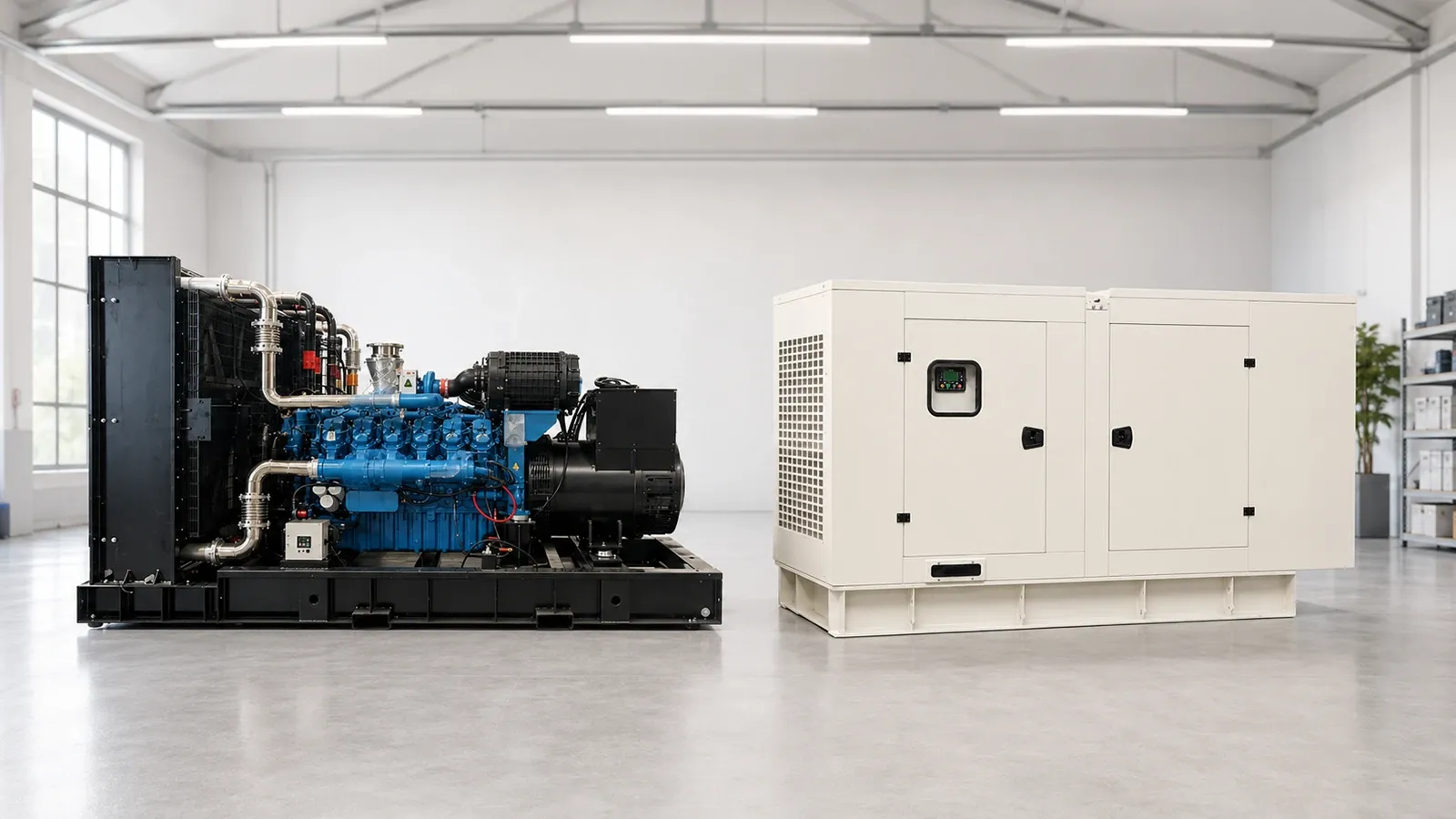
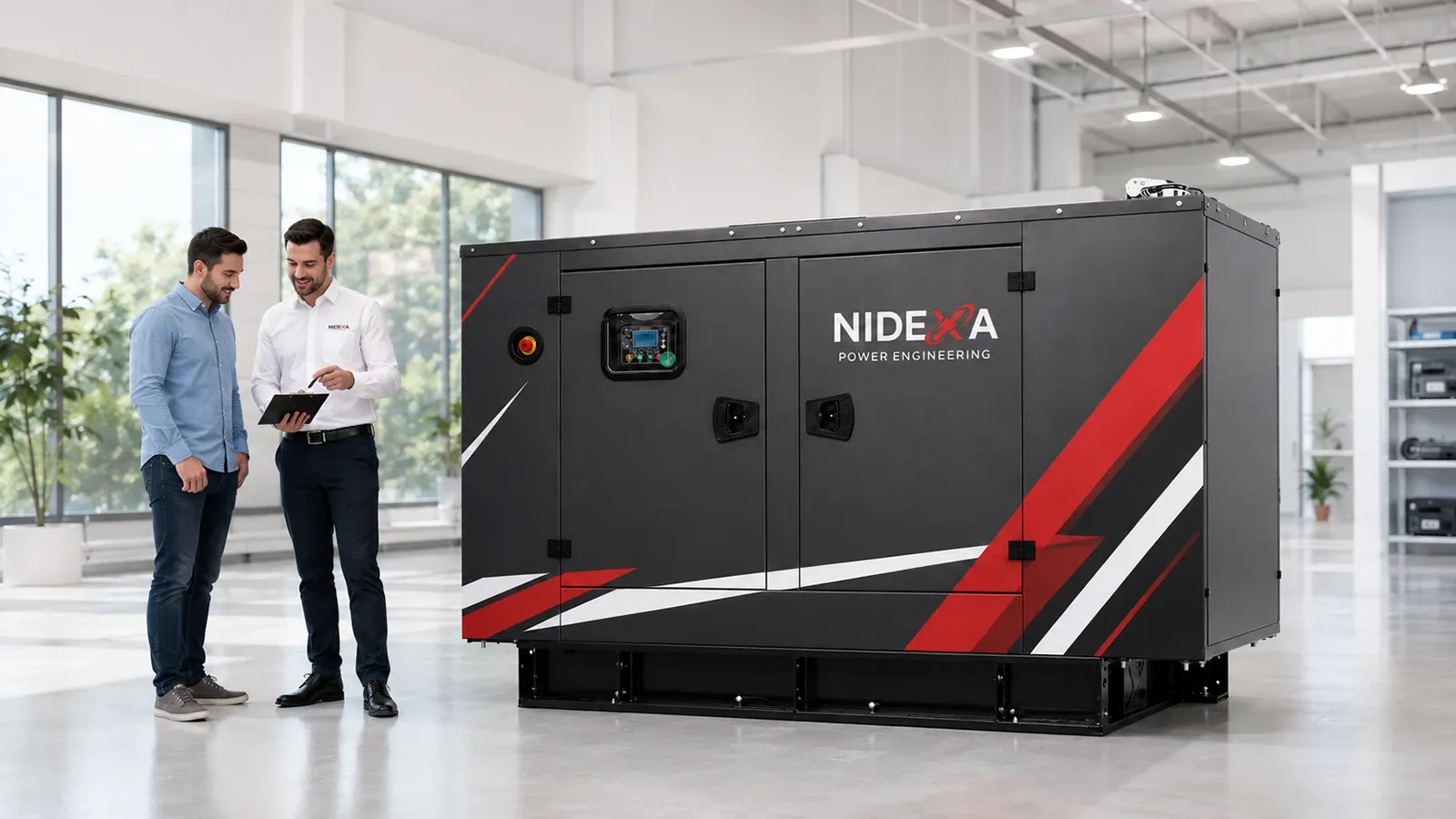
As Nidexa Jeneratör, from Maltepe / İstanbul, we offer open-type and enclosed diesel generators from 10 kVA to 1100 kVA with Perkins, Baudouin, Ricardo, Yangdong, and Shanghai Dongfeng engine options. To clarify the power suited to your facility together and choose the right model, you can talk to our generator sales team or request a quote right away. For the exact power, we provide guidance by assessing your usage scenario.
We help you choose the right generator
Get expert input on power sizing, installation and maintenance.