When buying a diesel generator, there is one topic that is just as important as power and fuel yet is often overlooked: generator noise level. The noise produced while the engine runs directly affects the installation location, your relationship with neighbors, and the comfort of employees. In this article, we cover how noise level is measured (dBA), why the decibel is a logarithmic scale, why the measurement depends on distance, and how the enclosed type known as a silent generator reduces noise, all in plain engineering language. You will also see why low noise is critical in residential, hotel, hospital, and office environments, and how you can reduce noise with distance and barriers.
What Is dBA? How Is Generator Noise Level Expressed?
Noise level is expressed in decibels (dB), a unit that describes how many times greater the sound pressure is relative to a reference value. For machines such as generators, however, the dBA unit is generally used. The "A" here indicates that the measurement is A-weighted, meaning it is corrected to account for the sensitivity of the human ear to different frequencies.
The human ear does not hear every frequency at the same intensity. It is more sensitive to mid frequencies and less sensitive to very low and very high frequencies. The dBA scale weights the sound measured by the microphone according to this hearing curve. In this way, the figure approximates how much noise a person actually perceives, rather than the energy the device physically produces. That is why the dBA value is used when evaluating a generator's noise level; because what really matters to you and your surroundings is the discomfort the ear hears.
In short, when it comes to generator noise level, what should come to mind is not how powerful the engine is, but the magnitude, in dBA, of the noise it spreads to its surroundings and that is felt by the ear while running.
Why Is the Decibel a Logarithmic Scale?
The point where most people trying to understand noise level get stuck is this: the decibel is a logarithmic, not a linear, scale. That is, 80 dBA does not mean twice the noise of 40 dBA. The difference is far greater than assumed.
This logarithmic structure has two fundamental practical consequences in everyday life:
- Roughly every 10 dBA increase is perceived by the ear as approximately "twice as loud." So a sound of 70 dBA feels about twice as disturbing as a sound of 60 dBA.
- Sound energy grows much faster. An increase of just 3 dB actually means the sound energy roughly doubles; yet the ear still perceives this difference as only "barely noticeable."
When these two points are considered together, the following emerges: dBA differences that seem small create large differences in comfort. Reducing a generator's noise level by 8-10 dBA may look modest as a number, but for the people nearby it is perceived almost as if the noise has been cut in half. To understand why the advantage provided by silent generators is so noticeable, you need to keep this logarithmic logic in mind.
Without Measurement Distance, the dBA Value Is Incomplete
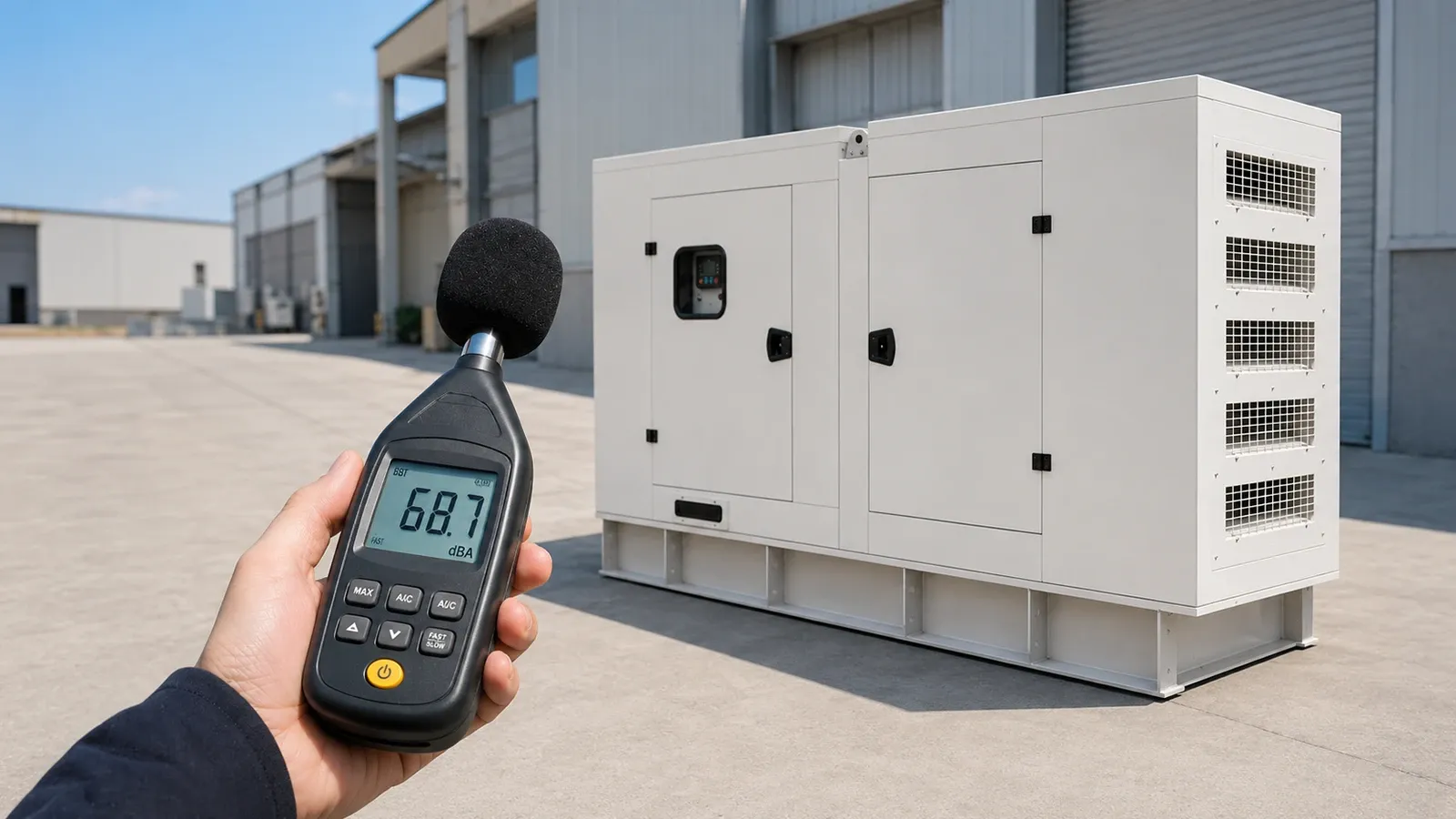
For a generator, the statement "the noise level is such and such dBA" is incomplete on its own without specifying the distance. Because sound weakens as it moves away from the source. The same generator gives a high dBA value when measured from 1 meter and a markedly lower one when measured from 10 meters.
In the industry, noise levels are generally given from a standard reference distance; this distance is often a value of about 7 meters, and in some cases 1 meter is also used. What matters is that, when comparing two generators, you look at values taken from the same distance. Placing figures given from different distances side by side produces misleading results.
In open space, that is, an open environment without large sound-reflecting obstacles, the noise level decreases by approximately 6 dBA each time the distance from the source doubles. This is an approximate rule; in the real situation, the nature of the ground, surrounding walls, and reflections affect the result. Still, the basic principle is clear: distance is one of the most powerful and cheapest tools of noise management.
Comparison With Everyday Sounds: Representative dBA Values
To make dBA figures concrete, it helps to compare them with familiar everyday sounds. The values below are representative and approximate; they vary depending on the environment and conditions.
| Sound source / environment | Approximate dBA | Perception |
|---|---|---|
| Whisper, very quiet room | ~30 dBA | Almost silent |
| Quiet office, library | ~40 dBA | Very calm |
| Normal conversation (1 m) | ~60 dBA | Comfortable, everyday |
| Heavy city traffic | ~80 dBA | Noticeably noisy |
| Near heavy machinery | ~95 dBA | Disturbing, prolonged exposure should be avoided |
In the next section we cover where a diesel generator's open type stands on this scale and how the enclosed type brings this value down.
Open Type and Silent (Enclosed) Generator Noise Level
A diesel generator of the same power can be offered on an open-type frame or placed inside a sound-insulated enclosure. Even if the engine and alternator are the same, the noise spread to the surroundings is very different in these two cases. The table below shows the difference between the open type and the enclosed type with representative values.
| Generator type (at approximately 7 m distance) | Representative dBA range | Comment |
|---|---|---|
| Open type | ~80-95 dBA | Engine and exhaust noise spread directly |
| Enclosed (silent) type | ~65-80 dBA | Reduced with a sound-insulated enclosure and silencer |
Remember what the difference in the table means on a logarithmic scale: the 10-15 dBA reduction provided by the enclosed type is perceived by the ear as a significant drop in noise, roughly a halving. This is the engineering behind the term "silent generator."
How Does a Silent Enclosure Reduce Noise?
An enclosed generator is the type in which the engine and alternator are placed inside a sound-insulated metal housing. Several mechanisms work together to reduce noise:
- Sound-insulated enclosure: The inner surface of the enclosure is lined with sound-absorbing material. This layer absorbs part of the sound waves produced by the engine, reducing their reflection to the outside.
- Exhaust silencer: One of the loudest sources of a diesel engine is the exhaust. The silencer softens the pressure pulses of the exhaust gas, markedly lowering this noise.
- Directed air inlets and outlets: Air needs to enter the enclosure to cool the engine. These openings are designed to limit sound escaping directly to the outside; air passes through, but the sound wave is absorbed more within the enclosure.
- Vibration isolation: Mounts that reduce the transmission of the engine's vibration to the frame and the ground also lower structurally transmitted noise.
All of these components together provide a much lower dBA value than the open type. You can find this and other advantages of the enclosed type, and its detailed comparison with the open type, in our article enclosed or open type.
Which Environments Require Low Noise?
Not every installation requires the same level of quietness. While the noise of an open-type generator at a remote construction site does not pose a major problem, in some environments low noise is a direct requirement. Typical places where the silent generator stands out are the following:
- Residential areas and surroundings: In installations close to apartment blocks, housing complexes, or homes, noise directly affects neighborly relations and living comfort. Low dBA becomes critical especially in backup power systems that need to run at night.
- Hotels and accommodation: Guest comfort is a decisive factor in hospitality. Where the generator is to be installed in the garden or within the facility, the noise reaching the room windows needs to be low.
- Hospitals and health facilities: Quietness is important for patient rest and general peace. In healthcare buildings, quiet operation of the system matters as much as backup power reliability.
- Offices and business centers: Continuous noise is disturbing for employee comfort and meeting environments. A generator installed nearby being a silent type protects work efficiency.
- Educational institutions and libraries: In these environments where quietness is directly part of the function, low noise is a priority criterion.
The common feature of these environments is that people are relatively close to the generator and sensitive to noise. In such places, noise level becomes a selection criterion as much of a priority as power.
Reducing Noise With Distance and Barriers
Choosing the enclosed type is not the only way of managing noise. A few decisions made during installation planning can also markedly reduce total noise. While the enclosure lowers noise at the source, the measures below make it harder for the sound to reach people:
- 1Increase the distance. Because in open space doubling the distance reduces the sound by approximately 6 dBA, placing the generator as far as possible from noise-sensitive areas is one of the most effective measures.
- 2Make use of obstacles and barriers. A wall, building facade, or a suitable acoustic barrier reduces noise in certain directions by blocking the path of the sound wave. It helps to position the generator so that there is an obstacle between it and the area where you do not want the sound to reflect.
- 3Choose the exhaust and air outlet direction correctly. Directing the exhaust outlet and the hot air discharge away from noise-sensitive windows and areas reduces the perceived sound.
- 4Pay attention to ground and vibration isolation. Suitable ground, vibration mounts, and correct installation reduce the low-frequency noise transmitted through the structure.
- 5Plan the installation location early. Noise management should be considered when the installation location is being chosen, not after the generator has been purchased. If the location, distance, and orientation are set up correctly from the start, no additional measures are needed later.
The correct application of these measures depends on the characteristics of the installation location. To plan the ventilation, exhaust, grounding, and acoustic layout together, you can make use of our installation and commissioning service. In addition, electrical and backup power systems should be handled within the framework of the relevant national regulations and standards; for precise rules, a qualified expert and official sources should be consulted.
Power Class and Operating Regime Affect the Noise Level
Noise level depends not only on the body type but also on the generator's power and how it operates. In general, as the power class increases, the noise source also grows, because the engine and cooling system require greater air flow and a larger exhaust. The sound character of a unit in the 10 kVA class and one in the 1100 kVA class is not the same.
The operating regime is also decisive. A backup power (standby / ESP) generator that engages when the grid is cut runs for a short time, whereas a continuously running prime (PRP) unit produces noise for long hours. In an installation that will run continuously, heat management and ventilation become more critical; this in turn affects air flow and therefore noise management. When choosing the right generator, power, operating regime, and noise level must be evaluated together. To estimate the power you need in advance, you can start with the power calculation tool on the site.
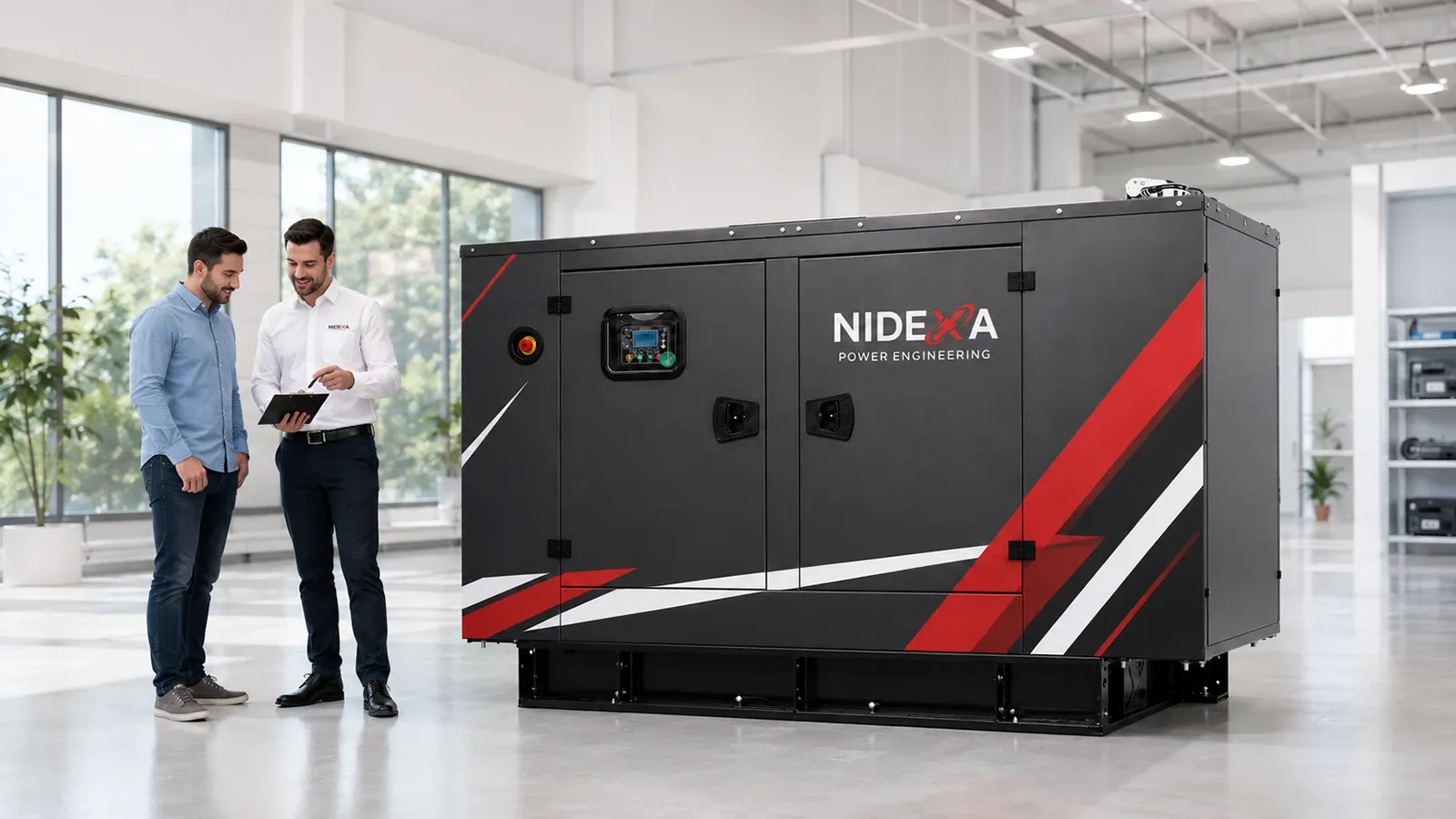
Among the enclosed products in the Nidexa range, you can evaluate silent-type solutions suitable for your installation location and noise sensitivity.
Frequently Asked Questions
What should the generator noise level be in dBA?
There is no single correct figure; the appropriate dBA value depends on the installation location. While a higher level may be acceptable at a remote construction site, the lowest possible value is targeted around homes, hotels, or hospitals. What matters is to always evaluate the noise level together with the measurement distance and to take into account the distance to noise-sensitive areas.
Is a silent generator really silent?
A silent generator does not eliminate noise entirely; it reduces it markedly compared to the open type. The reduction provided by the sound-insulated enclosure and silencer is perceived by the ear as a greater quietness than expected, because dBA is a logarithmic scale. In other words, the term "silent" means not absolute silence but a much lower, non-disturbing level of noise.
How does generator noise decrease with distance?
In open space, the noise level decreases by approximately 6 dBA each time the distance from the source doubles. For this reason, placing the generator far from noise-sensitive areas is one of the most effective and most economical ways of managing noise. The actual reduction may differ from this approximate rule due to the ground, surrounding walls, and reflections.
How much quieter is an enclosed generator than an open type?
The exact difference varies depending on the model, power class, and measurement distance. Representatively, the enclosed type can provide a value about 10-15 dBA lower than the open type. Because of the logarithmic scale, this reduction feels to the ear like the noise being cut roughly in half. These values are approximate and vary according to the technical data of the selected unit.
Which generator should be preferred around hospitals, hotels, and residences?
In these environments where people are close to the generator and sensitive to noise, the enclosed (silent) type is generally preferred. The low noise level provided by the enclosure, combined with a suitable installation location, distance, and orientation, produces a solution that preserves the comfort of the surroundings. For the final decision, the conditions of the installation location should be evaluated on site.
Conclusion: Plan the Noise Level From the Start
Generator noise level is not a problem to be dealt with after installation, but a criterion that should be planned from the start, at the purchasing and installation stage. Knowing that dBA is a logarithmic scale, that the measurement depends on distance, and how the silent enclosed type reduces noise makes it easier to make the right decision. Remember that dBA differences that seem small create large differences in comfort to the ear: when the right body, the right location, and the right distance come together, a powerful generator can run without disturbing its surroundings.
Just let us know the noise sensitivity of your installation location and your needs. As Nidexa Jeneratör, we offer open-type and enclosed diesel generator solutions, installation, and technical service support from Maltepe, Istanbul to all of Turkey. To determine together the silent generator solution suitable for your installation, get a quote or reach us at 0501 596 5246.
We help you choose the right generator
Get expert input on power sizing, installation and maintenance.