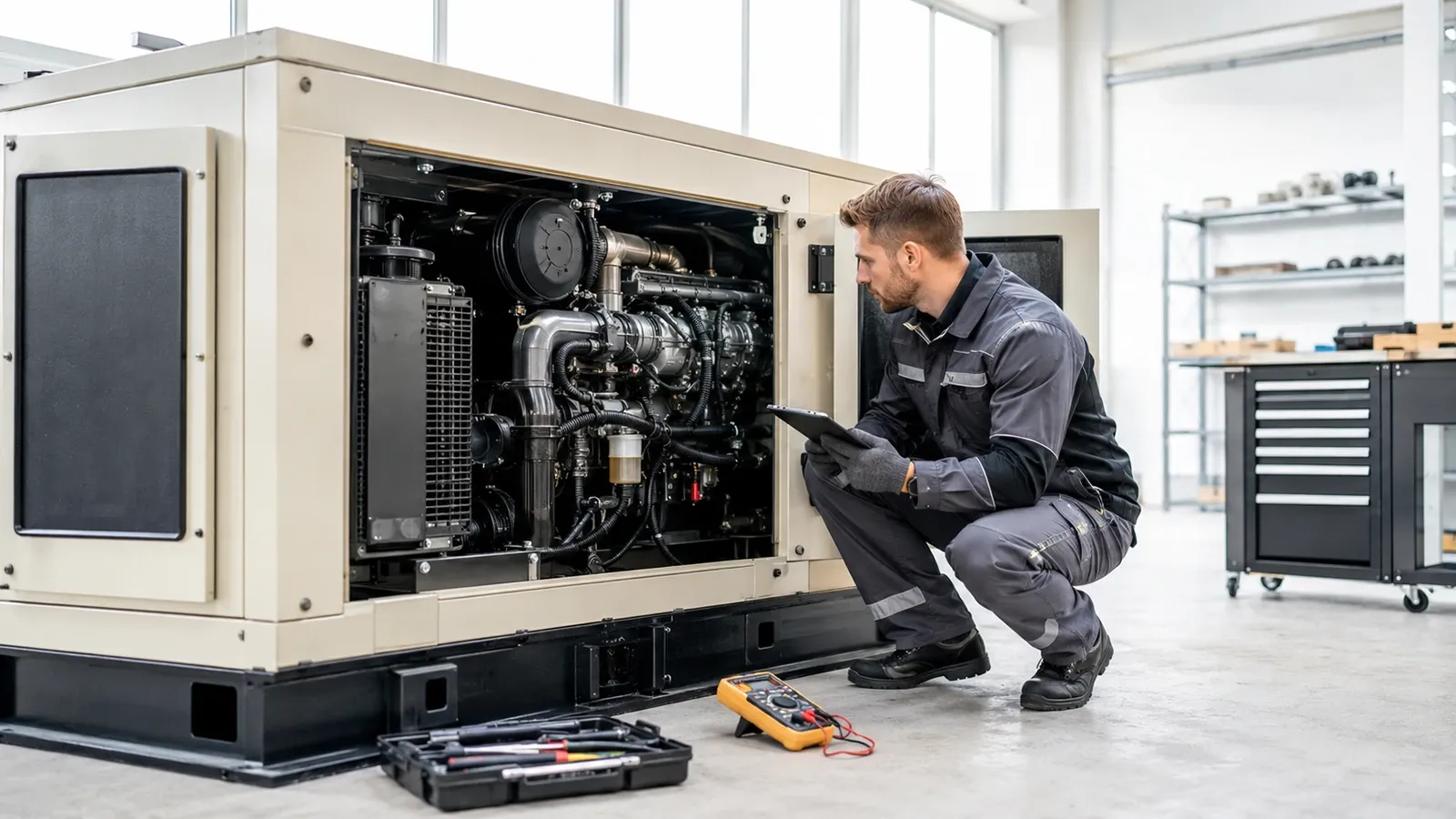
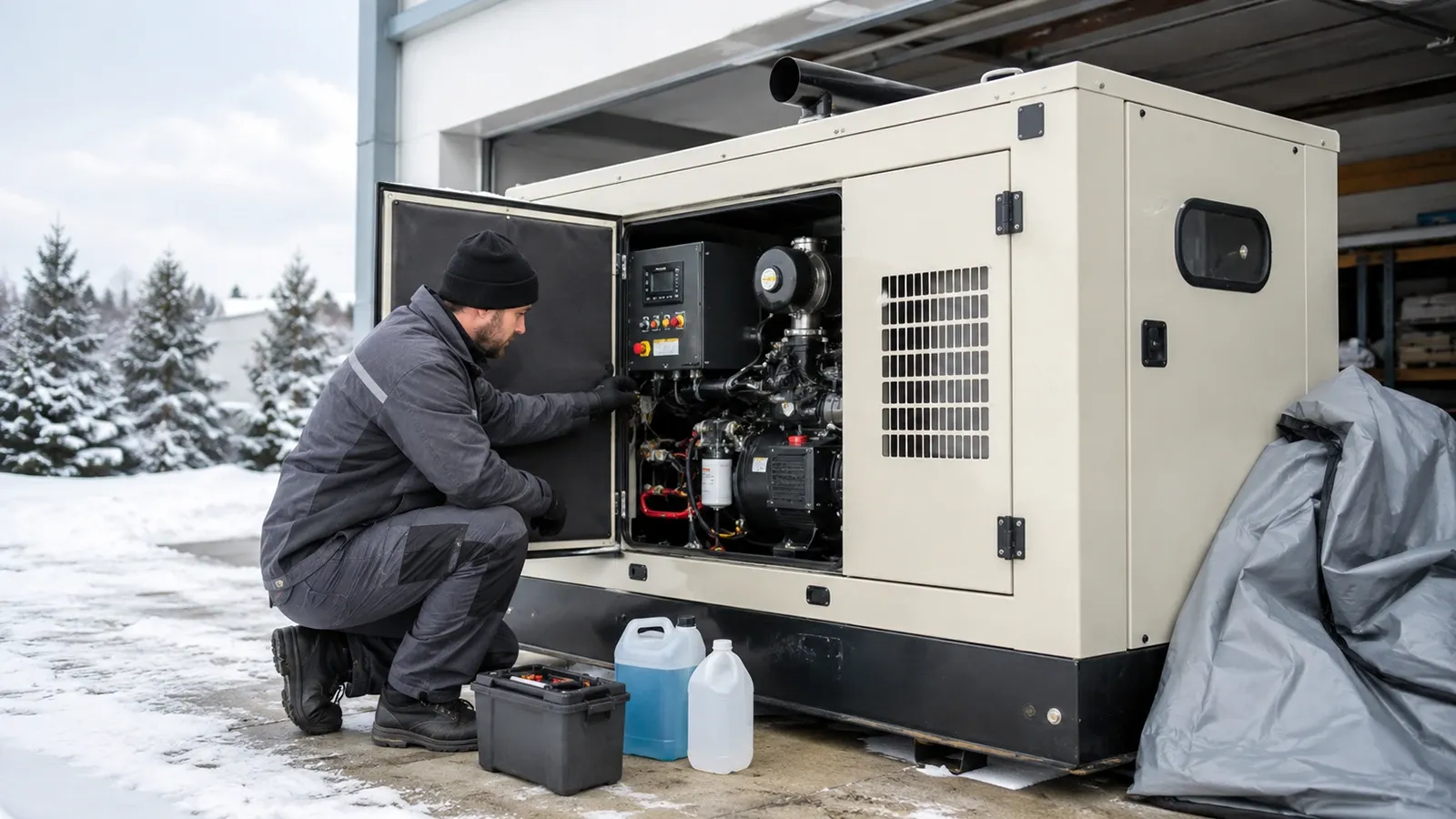
Winter is the season that strains a diesel generator the most. As the temperature drops, the engine starts with more difficulty, the battery loses part of its capacity, the fuel tends to gel and moisture starts to condense everywhere. In this article we cover running a generator in winter from start to finish; we explain what breaks down in the cold, why it happens and which practical measures you can take, in plain engineering language. You will also see, one by one, the generator storage steps for units that will not be used for a long time, namely the topics of fuel, battery, moisture, cover and periodic operation. Our aim is to make sure that when winter arrives your generator comes online without a hitch on the first try and makes it through to spring without wear.
Why Does a Diesel Engine Start Hard in the Cold?
In a diesel engine, ignition happens not with a spark plug but by compression. The air drawn into the cylinder is compressed to a high ratio by the piston, its temperature rises, and the fuel injected into this hot air ignites on its own. For this process to work, the air must heat up enough at the end of compression. When the air enters cold from outside, the temperature at the end of compression also drops and it becomes harder for the fuel to ignite. This is the fundamental reason why a diesel engine starts hard in the cold.
A few more factors add to this:
- Oil viscosity increases. Engine oil thickens in the cold and loses its fluidity. The starter motor has to spend more power to turn the moving parts rotating within the thickened oil.
- The battery weakens. At the same time, as we will touch on shortly, the battery loses part of its capacity in the cold. In other words, at the very moment the engine needs the most power, the source that cranks the starter is at its weakest.
- The combustion chamber heat escapes quickly. The cold metal block quickly absorbs the heat released by compression. This makes ignition even harder in the first cycles.
When these three factors come together, an engine that causes no problem in the summer months may struggle on the first start in winter. The solution is not to leave the engine completely cold at the moment of starting and to make sure the auxiliary systems (battery, fuel, coolant) are ready for winter.
The Role of the Block (Jacket Water) Heater
One of the most effective measures against the cold start problem is the block heater. Also known as the jacket water heater, this element is an electric heating resistor that warms the engine's coolant (the jacket water). It stays in operation continuously while mains power is connected and keeps the engine block at a certain temperature even while the generator is on standby.
The benefit is direct: because the engine is already warm, the air temperature at the end of compression starts from a higher point, the fuel ignites easily and the chance of coming online instantly on the first start increases. The block heater is practically essential especially for standby power (standby, ESP) generators that must take on load within seconds when the mains fails; because it takes time for a cold engine to be ready for full load, and this delay can be critical.
Another benefit of the block heater is that it protects the engine from cold loading. A freezing cold engine suddenly taking on load can cause thermal stress in internal parts and accelerated wear. Preheating reduces this sudden temperature difference and contributes to engine life. For a generator that will operate in winter conditions, it is wise to have the presence of the block heater, its electrical connection and the correct operation of its thermostat checked at the start of the season.
The Battery's Capacity Loss and Maintenance in the Cold
Your starter battery is one of the most critical parts determining whether the generator will start on the first try in winter. Lead-acid batteries can deliver less current in the cold because the chemical reactions inside them slow down. As the temperature drops, the power the battery can supply at the moment of starting decreases; in other words, precisely in winter when the engine demands the most current, the battery is at its weakest.
The table below shows how battery capacity changes with temperature using representative and approximate values. The figures vary depending on the battery type, its age and state of charge; for the exact value the manufacturer's data should be taken as the basis.
| Ambient temperature | Usable capacity (approximate) | Effect on starting |
|---|---|---|
| ~25 °C | ~100% | Reference, full capacity |
| ~0 °C | ~80% | Noticeable but manageable drop |
| ~ -18 °C | ~50-60% | Starting power drops significantly |
As you can see, the cold ties the battery's hands. The following maintenance steps are important for winter preparation:
- Check the state of charge. A weak or half-empty battery gives up much sooner in the cold. Have the charge level measured and topped up if necessary.
- Clean the connection terminals. Oxidized, loose terminal posts create resistance and reduce the starting current. A clean and tight connection makes a difference in the cold.
- Assess the battery's age and health. A battery that has reached the end of its life may get by in the summer but can fail on the first truly cold day of winter. A pre-season test prevents surprises.
- Keep the battery warm if possible. In some installations a battery heater or insulation is used to reduce the effect of the cold.
Battery-related problems are one of the most common reasons for a generator failing to come online in winter. Our article on common faults, where we have compiled what needs to be checked on a generator that will not crank or run, is a complementary resource on this topic.
Fuel Gelling and the Water/Moisture Problem in Winter
Diesel fuel can cause two different problems in the cold: gelling and water accumulation. Both of these are specific to winter and, if measures are not taken in advance, can stop the generator at the very moment of need.
Gelling (Paraffin Crystals)
Diesel fuel contains paraffin components. When the temperature drops enough, these paraffins start to crystallize; the fuel first turns cloudy, and as the temperature falls further it loses its fluidity and takes on a gel-like state. Gelled fuel can clog the fuel filter and, by preventing enough fuel from reaching the engine, cause the generator to stop or fail to run at all.
The basic solution against this problem is to use winter fuel. Diesel distributed in the winter months is formulated to be more resistant to gelling at low temperatures. If you have fuel left over from summer in your tank, you need to take this into account before the cold sets in. Fuel additives can also be used to improve flow properties; however, the choice and dosage of additive requires care in terms of fuel and engine compatibility, so it is sound to get an opinion from authorized technical support.
Water and Moisture
Water in the fuel tank is a separate headache in winter. Water can arise both through condensation (moisture accumulating on the inner surface of the tank due to the hot-cold difference) and from the moisture within the fuel itself. In the cold this water can freeze and clog the fuel lines and filter; it also creates the groundwork for corrosion and microbiological contamination in the fuel system.
For this reason, generator fuel systems include a water separator (fuel-water separator). The water separator collects the water that separates from the fuel; this water needs to be drained periodically. As you head into winter, these two habits are useful:
- Keep the tank full. Empty volume is more prone to water accumulation through condensation. Keeping the tank largely full reduces moisture condensation on the inner surface.
- Drain the water separator regularly. Discharging the accumulated water before it freezes and mixes into the system is a simple but effective part of safe operation throughout winter.
Coolant and Antifreeze Check
The engine's cooling system in winter does not only cool, it must also be protected against freezing. The antifreeze in the coolant lowers the freezing point of water and prevents the system from icing up in cold weather. If the antifreeze ratio is insufficient, the water in the engine block or radiator can freeze; the freezing water expands and can crack the block, the radiator or the hoses. Such damage is one of the most expensive and most preventable winter faults.
Before entering winter, the antifreeze ratio and general condition of the coolant should be checked. It is important that the mixture provides freeze protection suitable for the lowest temperatures of your region, that there are no leaks in the system and that the level is correct. Since antifreeze also serves as a corrosion inhibitor, timely renewal of a coolant that has reached the end of its life is valuable for engine health. The healthiest approach is to have these checks done at the start of the season as part of planned maintenance and technical service.
The Importance of Periodic Test Runs
The greatest enemy of a standby power generator is waiting for a long time without ever running. In winter this risk increases; because the unit perhaps only waits for months and is strained for the first time when it is truly needed. Periodic test runs are precisely there to prevent this surprise.
A test run performed at regular intervals does several jobs at once:
- Shows the battery's state of charge and health under real conditions.
- Warms the engine, circulates the oil through the system and helps protect internal parts from moisture.
- Confirms that the fuel system, the starting system and the control panel work as expected.
- Reveals a possible problem in a controlled test rather than at the moment of a critical outage.
The frequency and duration of the test run are determined by the type of generator, its usage regime and the manufacturer's recommendations. The general principle is to run the unit at regular intervals and, if possible, allow it to warm up under some load. Avoiding long, unloaded and very short runs prevents secondary problems such as condensation and incomplete combustion.
Long-Term Storage: Steps for the Period It Will Not Be Used
If a generator will not be used at all for a certain period (for example throughout a season), instead of just leaving it, it needs to be properly prepared for storage. Correct generator storage protects the unit from moisture, corrosion, fuel deterioration and battery discharge. The following steps are a basic checklist for the period it will not be used.
| Step | What to do | Why |
|---|---|---|
| Fuel | Prepare the tank appropriately, drain the water separator | To prevent gelling, water and fuel deterioration |
| Battery | Charge it, remove it if necessary, store in a warm and dry place | To prevent discharge and freezing in the cold |
| Moisture | Provide a dry environment, take precautions against condensation | To prevent corrosion and electrical problems |
| Cover / lid | Use a suitable, breathable cover | To protect against dust and water without trapping moisture |
| Periodic operation | Run it regularly even while in storage | To keep the system alive and dry |
Fuel
In long-term storage, fuel can deteriorate over time, draw water and become open to microbiological contamination. How the fuel system should be prepared before storage (the fill level of the tank, use of additives, draining the water separator) varies depending on the unit and the duration. Since an incorrect application can lead to sediment and clogging in fuel that waits in the tank for a long time, it is wise to get technical support at this step.
Battery
An unused battery slowly discharges on its own; and in the cold a discharged battery can freeze and suffer permanent damage. Keeping the battery charged during storage, removing it from the unit when necessary and storing it in a warm and dry place, or maintaining the level with a suitable charger, is decisive for battery life.
Moisture and Condensation
Moisture is the most insidious enemy of long-term storage. Water condensing on metal surfaces with temperature changes causes corrosion, and in electrical connections it leads to poor contact and faults. It is important that the storage area is as dry as possible, that the unit does not directly contact a damp floor and that moisture-preventing measures are taken if necessary.
Lid and Cover
It makes sense to cover the generator to protect it from dust and water; however, wrapping it tightly with an airtight plastic sheet backfires. A non-breathable cover traps moisture underneath it and accelerates corrosion. Instead, a suitable cover that breathes, is water-repellent but does not hold air should be preferred. Enclosed-type units are already more resistant to external conditions; open-type units, on the other hand, require additional protection if they are to be stored outdoors. You can review the differences between open type and enclosed type on our products page.
Periodic Operation
Even a generator waiting in storage should be run from time to time. Regular operation warms the engine and drives away moisture, allows the oil to reach the parts, keeps the battery charged and helps the system stay generally alive. A unit that waits completely motionless is much more likely to cause problems when it is needed again.
Winter Preparation Checklist
Let us reduce the topics above to a practical list. Before winter arrives, it is useful to check the following on your generator:
- 1Verify that the block (jacket water) heater works and that its electrical connection is sound.
- 2Have the battery's charge, health and terminal connections checked.
- 3Assess whether the fuel is suitable for winter conditions and drain the water separator.
- 4Have the antifreeze ratio and level of the coolant checked.
- 5Make sure the engine oil is suitable for the season.
- 6Review your periodic test run plan.
- 7If you will not use it for a long time, apply the storage steps.
Most of these checks can be completed in one go together with a planned maintenance carried out at the start of the season. If you want to reassess the power class you need, you can also start with the power calculation tool on the site.
Frequently Asked Questions
What should I check first if my generator does not run in winter?
On a generator that fails to come online in winter, the most common points of suspicion are the battery and the fuel. A battery whose capacity has dropped or that has weakened in the cold may not be able to crank the starter; gelled fuel or a clogged filter can prevent fuel from reaching the engine. The block heater not working also makes the cold start harder. You can find the check steps in our common faults article, and in situations you cannot resolve you can turn to technical service.
Should the block heater stay on continuously?
On generators intended for standby power that must come online at any moment, the block heater is generally kept in operation continuously while mains power is connected; this way the engine is always warm and ready to start. The heater's thermostat keeps the temperature within a certain range. It is healthiest to assess the setting suitable for your usage regime and correct operation together with technical service.
Why does diesel fuel gel in winter and how is it prevented?
The paraffin components in diesel fuel crystallize when the temperature drops enough, turning the fuel gel-like and possibly clogging the filter. The most basic measure is to use winter fuel, which is formulated to be more resistant to low temperatures in the winter months. Suitable fuel additives can also help; however, technical advice should be sought for the choice and dosage of additive.
How often should I run the generator?
It is recommended that standby power generators not wait for a long time without ever running; regular test runs keep the battery and fuel system alive, and warm the engine to drive away moisture. The exact frequency and duration are determined by the type of the unit, its usage regime and the manufacturer's recommendations. It is best to clarify the suitable interval with the support of technical service.
How should I store a generator I am not using in winter?
When preparing a unit that will not be used for a long time for storage, keep in mind the topics of fuel, battery, moisture, cover and periodic operation: prepare the fuel system appropriately, keep the battery charged and warm, leave the environment dry, use a breathable cover and run the unit from time to time. Since the details vary depending on the model and conditions, the manufacturer's instructions and technical service should be taken as the basis.
Conclusion: Meet Winter Prepared
Your generator getting through winter without problems depends largely on a few correct steps you take at the start of the season. Knowing why a diesel engine struggles in the cold, having the block heater, battery, fuel and coolant checked, and building the habit of regular test runs prevent most winter faults before they even appear. And if you will not use it for a long time, storing the unit correctly with the fuel, battery, moisture, cover and periodic operation steps greets you with an effortless start in spring.
If you want to plan your generator's winter preparation or long-term storage, we at Nidexa Jeneratör are by your side. From Maltepe, Istanbul, we offer diesel generator solutions from 10 kVA to 1100 kVA across all of Turkey, along with installation, technical service and maintenance support. For winter preparation maintenance and inspection, get a quote or reach us at 0501 596 5246.
We help you choose the right generator
Get expert input on power sizing, installation and maintenance.